
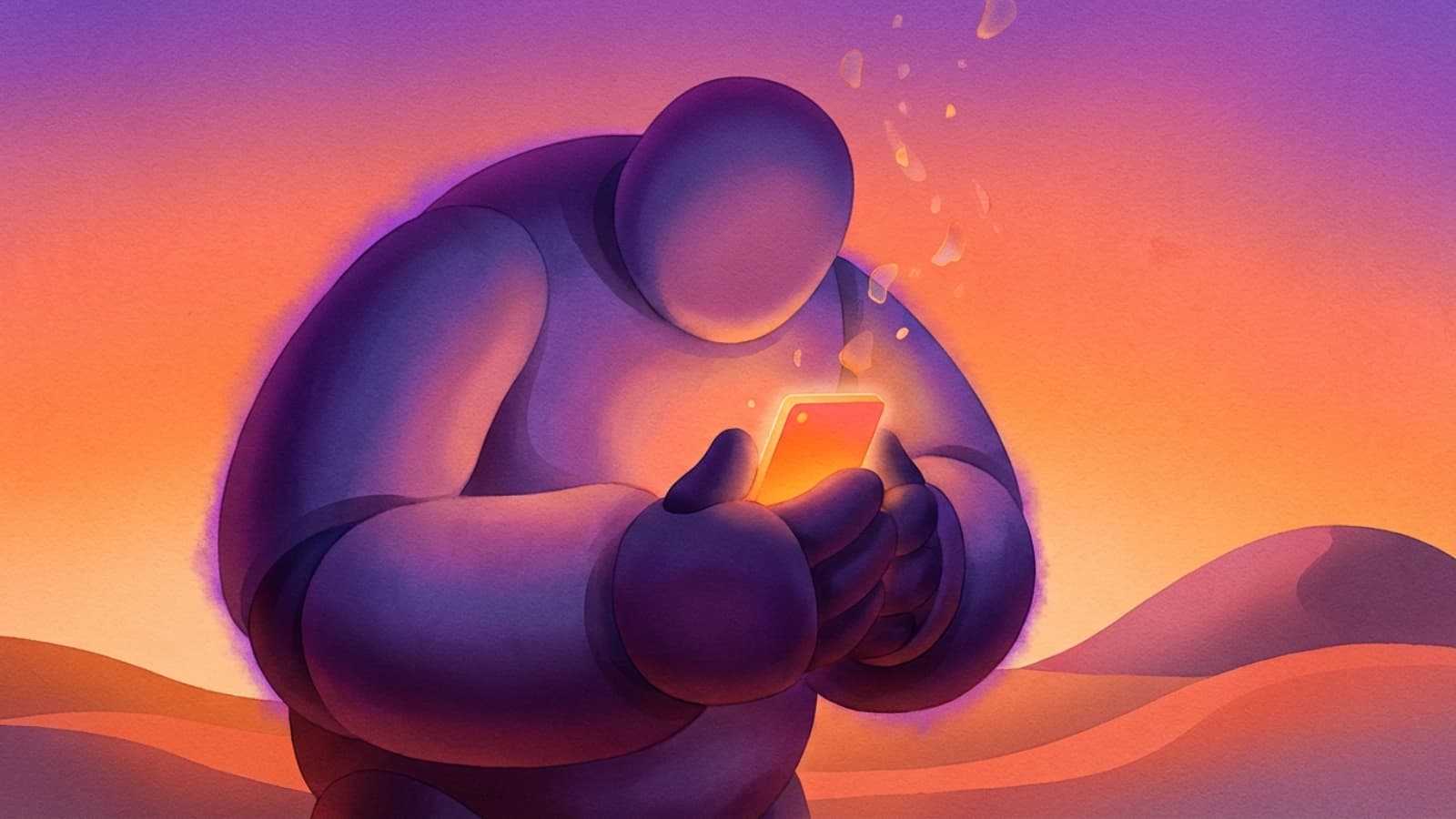
You can't tell who's human online anymore. Once that uncertainty spreads, the entire premise of social media collapses. We're watching the erosion of digital trust itself, the assumption that made online connection possible.
The trajectory was set early. Social media started with a simple constraint: connecting people you already knew. Facebook required college email addresses, Myspace was for finding actual friends. Relationships preceded the platform. The digital infrastructure served physical-world connections, nothing more.
That model had a ceiling: the number of people you actually knew. Facebook hit it around 2007, and rather than accept the limit, they changed the game. The business model demanded growth, so platforms pivoted from connection to engagement. Time spent scrolling became the metric, algorithmic feeds replaced chronological ones. Content that maximized attention got amplified, regardless of authenticity. Influence scaled without limit.
The shift created the opening AI needed. When platforms select for attention regardless of source, they're selecting for whatever can produce engaging content most efficiently. Humans tire, run out of ideas, and can't A/B test personas while sleeping. AI has none of these constraints.
The infiltration was inevitable, and it came in waves starting with text first. By 2023, GPT-4 wrote tweets and forum posts indistinguishable from humans. You've argued with AI without knowing. Images followed in late 2024 into early 2025 when Midjourney and OpenAI's 4o Image Generation crossed into photorealism. A fitness influencer's entire portfolio (beach shots, gym selfies, smoothie bowls) generated in an afternoon. A travel blogger's year in Southeast Asia rendered on a laptop in Ohio. Instagram filled with faces that never existed, and the tells we once relied on vanished as models improved.
Video is falling now. Sora launched in 2024 and by 2025 it crossed into believability. The uncanny valley remains if you scrutinize frame by frame, but it's closing fast. Video was the last refuge, the final format where we could default to trust. In a year, that's gone.
Platforms spent years learning engagement optimization: testing, iterating, maximizing scroll time. Influencers attempt to understand and learn these system but are inefficient while AI creators are trained on that knowledge and accelerated it, running at machine speed. They generate a hundred post variants overnight, track performance, and adapt to trends in real time. Test persona after persona until something resonates. No creative exhaustion, no reputational risk, no sleep. The iteration speed alone tilts the playing field.
The algorithm doesn't distinguish between human and synthetic. It measures engagement. AI content engages, so the algorithm amplifies it. The feedback is obvious and self-reinforcing.
Every interaction becomes suspect. You read a comment and wonder: person or AI? The cognitive load is constant and exhausting. You scroll slower, second-guess your reactions, read every post with forensic attention instead of fluid trust. Every click costs you something. Trust used to be the default. Now doubt is.
Think of invasive species: introduce an organism without native predators and it explodes, crowding out everything that evolved with constraints. AI content has no constraints. Platform defenses were built for human-scale threats and can't adapt fast enough.
This leads to two sharply divergent futures.
First: AI dominance. Social media becomes fully synthetic. Humans scroll and engage, but content shifts toward algorithmic personas optimized for attention, and while platforms may not explicitly choose this path, engagement is their business which makes it inevitable. AI content performs, algorithms show more of it, and humans compete but lose gradually, the way chess players lost to engines. Not because they stop trying. Because the ceiling is lower.
Social media keeps its addictive mechanics and sheds its meaning. It becomes pure entertainment, not connection. You scroll through algorithmic feeds, consume algorithmic content, form parasocial bonds with entities that don't exist. The original premise (talking to people you know) becomes a historical footnote, something early users remember but new users never experience.
For pure entertainment, this works. But the platform itself becomes unviable for anyone seeking connection. Once the space becomes majority-synthetic, genuine interaction becomes impossible. You can't tell who's real. Even genuine accounts become suspect. The platform can't serve two masters when users can't distinguish between them, and the presence of one degrades the other. Without that distinction, connection dies and the platform becomes something else entirely.
Second: rejection. AI saturation becomes so pervasive that people walk away en masse. Not to competing platforms (because those fill with AI too) but back to physical space. Connection that requires two people in the same room and can't be synthesized or scaled.
Social media's end is actually a return, a correction toward something older and more sustainable. The AI flood becomes the catalyst pushing people back to IRL human contact. Social media contracts into a niche for synthetic entertainment. Real connection moves offline.
This path is plausible. Smoking was sophisticated until it wasn't. MySpace was cool until it was embarrassing. The products didn't change, the social meaning did. Norms flip fast once they start.
The trigger is awareness reaching critical mass. Not just "I suspect some accounts are AI," but "everyone knows most accounts are AI, and everyone knows everyone knows." Once that threshold hits, social meaning shifts. Connection becomes consumption. Cool becomes cringe.
There's an edge case: some users actively prefer the synthetic version. If you're using social media for entertainment rather than connection, AI content might be superior: more optimized, more consistent, always available. You don't need TV characters to be real people. AI feeds could become explicit entertainment rather than pretend-connection.
But mixing these modes destroys both. When you can't distinguish entertainment from connection, neither works. The uncertainty contaminates everything. The two modes need separation. Platforms aren't providing it.
Social media was built for connection and became an engagement maximization engine. AI is now exposing the contradiction. You can have algorithmic optimization or human connection, but not both in the same space. The system is brittle because it promised connection and authenticity but delivered optimization and algorithmic selection. Those contradictions were sustainable as long as the content was human. Once it's not, the foundation cracks.
Users will choose or algorithms will choose for them. If enough people notice what's happening and opt for connection over consumption, the AI saturation becomes self-limiting. Not because the technology fails, but because people reject what it produces.
Brittle systems don't decay. They break. This one is already broken.